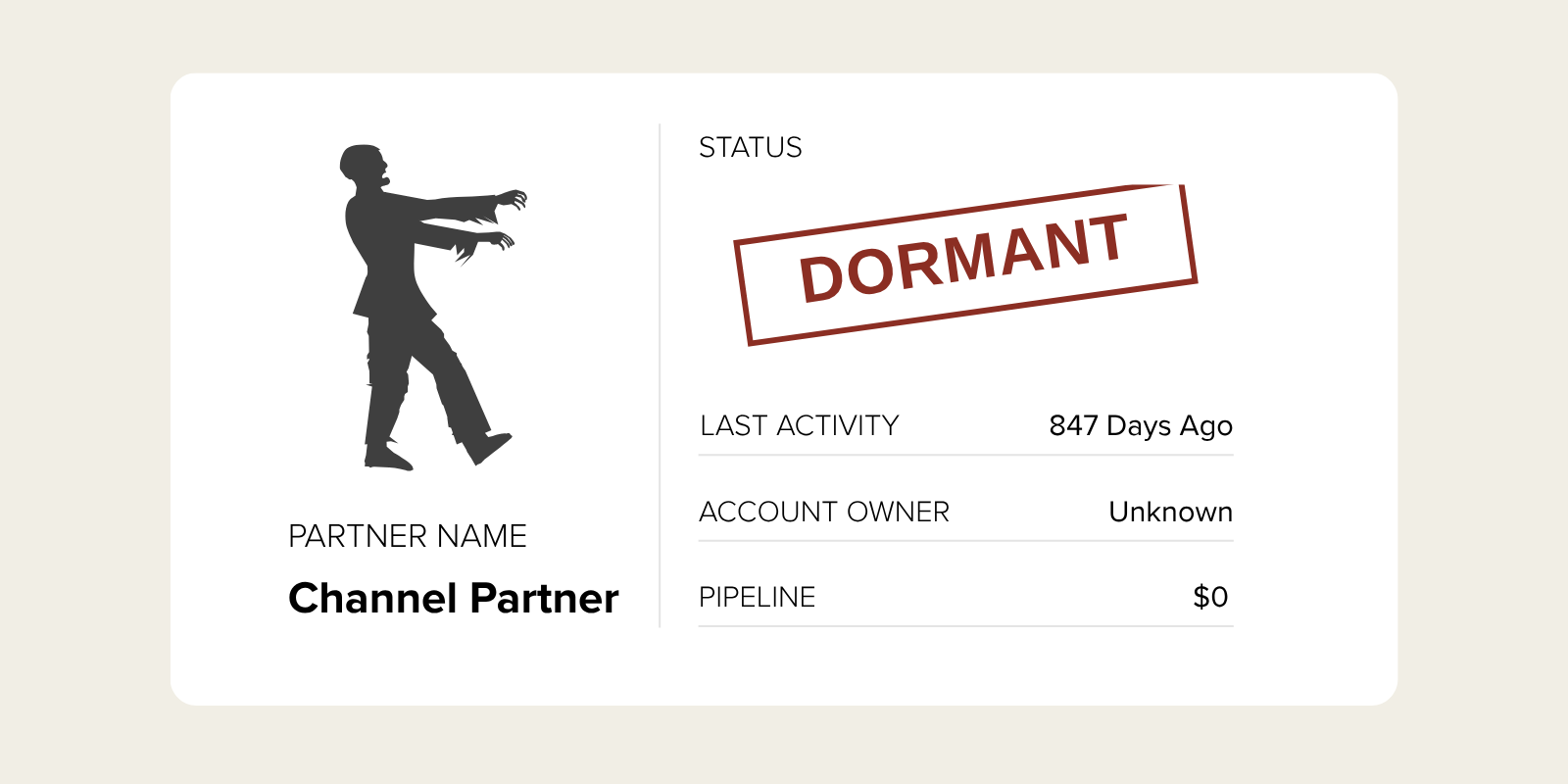

Inactive partners are the clearest sign that partner lifecycle management stopped after onboarding
Every partner program has them.
Not the partners actively selling, implementing, influencing, or building solutions around your offering. Not the ones showing up to business reviews, attending enablement sessions, or bringing new opportunities to the table.
I'm talking about partners who still exist in your systems and nowhere else.
They signed an agreement years ago. They still appear in reports. They still receive partner communications. They may even hold a tier designation. Yet if you asked your partner managers when they last generated pipeline, registered a deal, completed a certification, or even had a meaningful conversation about growing the business together, the answer is often the same: "I'm not really sure."
They're not active partners. They're what I call zombie partners, the walking dead. And unlike the entertaining kind, these aren't just wandering aimlessly feeding on brains. They're quietly consuming your program's most valuable resource: focus.
Every dollar spent onboarding the wrong partners, every enablement of companies that won't ever build a business with you, and every partner manager stretched across inactive accounts reduces the return on your partner investment.
Zombie partners don't just take up space. They eat your bandwidth, distort your metrics, and if left unchecked, feast on the strategic attention that should be feeding your best partnerships.
Most partner leaders know they exist. Few have a strategy for dealing with them. Research from The Channel Company found that 41% of partners who stopped selling a vendor's solutions never formally left the program. They simply became inactive. Overall, 70% either disengaged or ended the relationship altogether in the previous twelve months. Dormant partners don't announce themselves. They just quietly become zombies.
Why Partner Lifecycle Management Breaks Down After Onboarding
Partner lifecycle management usually stops after onboarding. Organizations build recruitment engines, onboarding programs, and partner portals, then leave everything after that unstructured. Partners go quiet gradually. Engagement declines, champions leave, priorities shift, and the partner stays in the program because nobody owns the decision about what happens next.
Most partner teams focus on the front end of the partner lifecycle. They build recruitment engines. Create onboarding programs. Launch partner portals. Attend events and celebrate new signings. What happens after that is rarely as structured.
Partners become inactive gradually. Business plans are forgotten. Months become years.
Contrast that with how most organizations manage customer relationships. Imagine if your customer success team never reviewed account health, never measured engagement, never identified accounts at risk. Most executives would consider that unacceptable. Yet the partner equivalent, a structured and ongoing motion for monitoring partner health, is missing from most programs.
The Cost of Carrying the Walking Dead
Inactive partners cost you focus, and focus is everything in a partner organization. When your coverage model is stretched across 400+ partners and 350+ are essentially dormant, you're not managing an ecosystem. You're managing a mailing list. The gap between reported scale and actual contribution has a way of surfacing at the worst possible moments.
At first glance, inactive partners may seem harmless. What's the downside of leaving them in the program?
Board reviews. Investor conversations. Competitive positioning discussions. Those are the moments when partner count and partner contribution get compared side by side, and the difference between the two becomes very hard to explain.
Partner count is easy to measure. Partner contribution is what matters. Healthy ecosystems aren't built by accumulating partners. They're built by helping the right partners succeed.
Before You Write Them Off, Ask Why
Zombie partners rarely became zombies on their own. Before you clean house, understand what happened. Inactive partners are usually a symptom of a breakdown somewhere in the partner experience, not evidence of poor partner quality. What they went dark about is often the most useful feedback your program will get.
The mistake many organizations make is treating inactive partners as a cleanup list. A mass email, a grace period, a purge. Problem solved.
When a partner goes dark, it's worth understanding the story:
- Did they fail to see a path to profitability?
- Did onboarding stop at product training instead of helping them build a business?
- Did your field team work around them instead of with them?
- Did friction in your program make engagement simply not worth the effort?
- Was it something else entirely?
A partner who never found success with your company may be telling you something important about your program, your onboarding, your alignment model, or your incentive structure. That's worth understanding before you decide what to do next.
The Diagnostic Trigger: Three Questions That Identify a Zombie Partner
Here's a simple test. If you can't readily answer these three questions about a partner, that's your signal to act:
- Recent contribution. When did this partner last generate or influence a customer opportunity?
- Business change. What has changed in their business since they joined the program?
- Ownership. Does anyone in our organization actively own this relationship right now?
If the answers are "I don't know," "I don't know," and "I don't think so," you have a zombie partner situation and an ownership gap. Both are solvable. But you have to know they exist before you can address them.
Revive or Retire: How to Evaluate Dormant Partners in Three Stages
Evaluate dormant partners in three stages: assess current fit and intent, understand what has changed in their business, then build a tailored activation plan or transition them out. Partners who already know your company, products, and processes can often be reactivated more efficiently than recruiting and ramping someone new.
The foundational relationship is there. The goal is to rebuild the business rationale and eliminate whatever friction caused the drift. You need a structured process for evaluating dormant partners, not a one-time audit, but a repeatable motion built into how you manage the ecosystem.
Stage 1: Assess Current Fit and Intent
Before investing in a revival effort for a partner, determine whether the fundamentals are still there. Are they still operating in a market where your offering is relevant? Do they have the technical capability and customer access that made them attractive originally?
Also, is there any signal of intent, even passive intent? They opened your last email. A rep mentioned their name. They attended a virtual event. That's worth noting. Some partners will be obvious retirement candidates at this stage. That's valuable information, not a failure.
Stage 2: Understand What's Changed
For partners that pass the fit assessment, understand the current state of their business, not the state it was in when they signed. Companies evolve. Customer focus changes. Service models shift. Your offering may have been a perfect fit two years ago and a marginal fit today, or the reverse.
This isn't a discovery call. It's a genuine conversation about where their business is headed and whether there's a credible path to mutual value. Come with questions, not a pitch.
Stage 3: Build a Tailored Activation Plan
If the conversation confirms real fit and genuine interest, the revival effort begins, and it has to be tailored, not templated. What enablement does this partner actually need given where their business is today? What joint go-to-market motion makes sense given their customer base and your current solution set? What does a realistic 90-day plan look like, one that accounts for who they are now?
For partners where the conversation doesn't surface a credible path forward, a respectful transition to inactive status isn't a failure. It's good ecosystem management, and it frees resources for partnerships that can actually grow.
A Better Measure of Ecosystem Health
Ecosystem health is measured by active contribution, not partner count. Stop asking how many partners you have. Ask how many are closing deals, influencing wins, generating pipeline, staying current on enablement, and investing in solutions around your offering. Those answers reveal far more than a roster count ever will.
Great ecosystems aren't measured by the partner logos they collect. They're measured by the partners actively creating customer success.
The strongest partner organizations continuously recruit, develop, evaluate, and when necessary, retire partners. They understand ecosystems evolve. Not every relationship is meant to last indefinitely. But every active partner deserves a path forward: to meaningful growth, contribution, and customer impact.
The walking dead may make for great entertainment. But they make for a weak ecosystem, and very long partner leadership meetings.