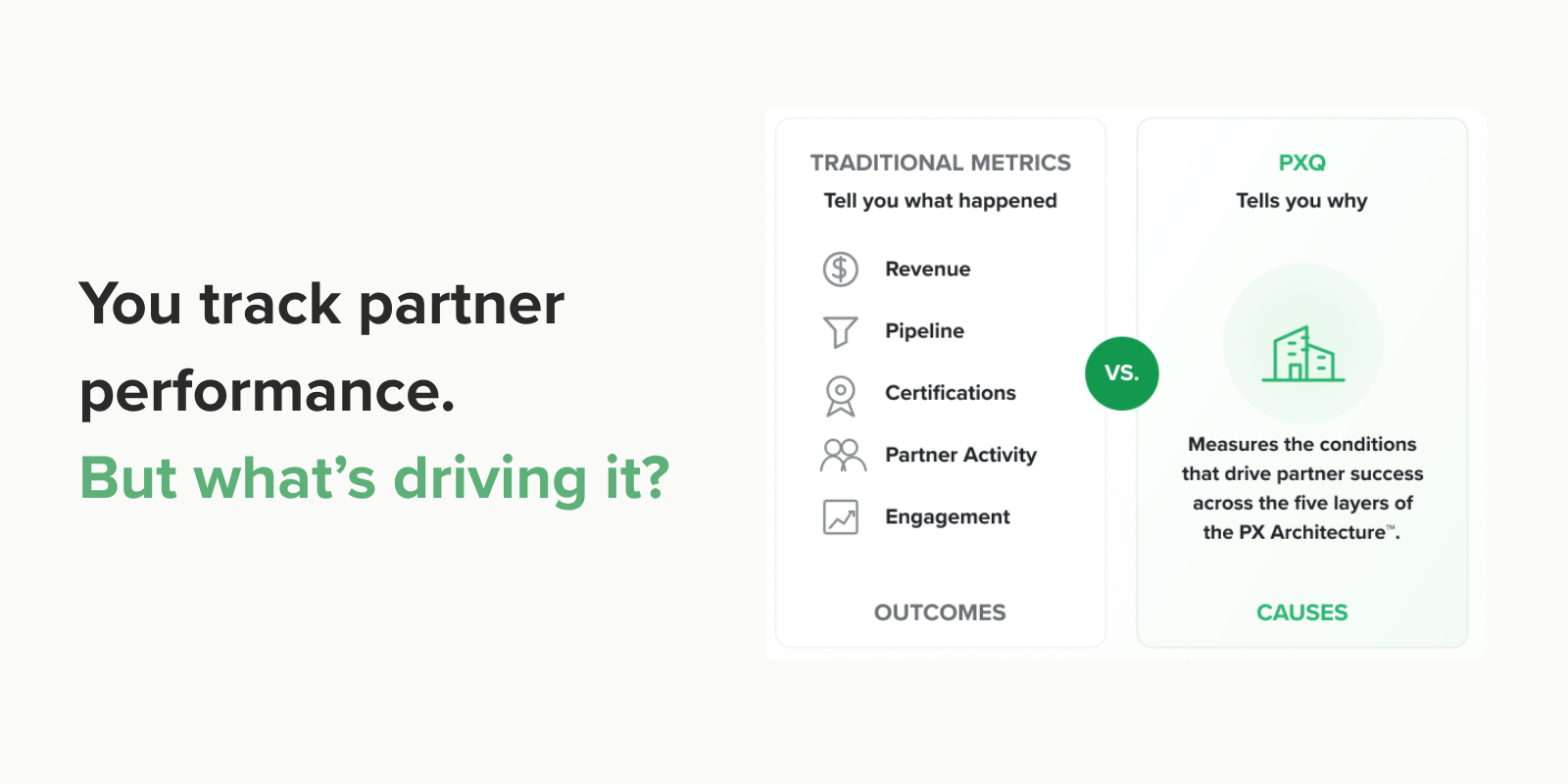

Introducing the Partner Experience Quotient (PXQ™): a new way to measure how well your organization is positioned to enable partner success
Partner organizations are not short on partner performance metrics. What most lack is a measure of partner experience: the organizational conditions that determine whether partners can actually succeed. The Partner Experience Quotient (PXQ™) is that measure. It scores how well your organization is positioned to enable partner success.
Most partner teams can report how many partners they have recruited, how many have completed onboarding, how many certifications have been earned, how frequently the partner portal is being used, and how much pipeline or revenue the ecosystem has generated.
Those measures are important, but they primarily tell you what has already happened. They do not always explain why those results occurred, why some partners are more productive than others, or where the organization should focus to generate more value from the investments it has already made.
That creates a significant challenge for partner leaders. When performance falls short of expectations, the response is often to launch another program, recruit more partners, add more enablement, introduce a new incentive, or invest in another technology platform. Each initiative may address a legitimate need, but without a clear understanding of the broader partner experience, organizations can struggle to determine which actions will produce the greatest impact.
The real opportunity is not simply to do more. It is to understand the organizational conditions that shape partner success and identify where focused improvements can accelerate engagement, productivity, revenue, and growth.
That is the purpose of the Partner Experience Quotient (PXQ™).
Why Partner Performance Starts With Partner Experience
Partner performance starts with partner experience because partners choose where to invest.
Partners have more vendors competing for their time, attention, resources, and investment than ever before. They cannot master every solution, participate in every program, or pursue every opportunity placed in front of them. They make choices about which vendors to prioritize based on the strength of the market opportunity and the experience of working with the organization behind it.
A compelling product may attract a partner's initial interest, but the broader partner experience determines whether that interest becomes sustained investment and performance. Partners need to understand the strategy, see a credible path to profitability, access the right resources, engage the right people, navigate processes efficiently, and bring solutions to market with confidence.
When those elements work together, partners can become productive faster, engage more deeply, and create greater value for customers. When they do not, even highly capable partners may shift their attention to vendors that make success easier to achieve.
That is why partner experience has become a competitive advantage. It influences which vendors partners prioritize, how effectively they execute, and whether they become occasional participants or committed advocates.
Partner Experience is the difference between vendors partners tolerate and vendors they enthusiastically evangelize.
What Traditional Partner Performance Metrics Miss
Traditional partner performance metrics report outcomes: pipeline, revenue, deal registrations, certifications, and portal activity. They confirm what happened. They do not measure the organizational conditions that produced those results, which is why two programs with nearly identical metrics can have very different capacity to grow.
Organizations rely on standardized measures to understand nearly every important area of the business. Financial metrics evaluate business performance. Customer Satisfaction and Net Promoter Score provide insight into customer perceptions and loyalty. Employee engagement measures help leaders assess the health of the workforce and organizational culture.
Partner teams have traditionally lacked a comparable score for evaluating the strength of the environment they create for partners.
Partner satisfaction surveys can reveal how partners feel about individual aspects of the relationship. However, these measures do not provide a complete view of how effectively the organization is structured to enable partner success. Consider three common patterns:
- Strong revenue, concentrated risk. A company may have strong partner-sourced revenue but rely too heavily on a small number of highly productive partners.
- Executive support without execution. Another may have significant executive commitment but lack the processes required to turn strategy into results.
- Investment without clarity. A third may have invested heavily in enablement and technology while partners continue to experience inconsistent communication, unclear expectations, and difficulty engaging internal teams.
Looking at each issue independently makes it difficult to see how the pieces connect. Partner experience is cumulative. It is shaped by strategy, leadership, operating principles, ecosystem design, programs, processes, technology, measurement, and the interactions partners have across the organization.
Without a way to evaluate those elements as a connected system, improvement can become guesswork.
What Is the Partner Experience Quotient (PXQ)?
The Partner Experience Quotient (PXQ™) is a score that measures how well your organization is positioned to enable partner success. If IQ measures intelligence, the PXQ measures the operational intelligence of your partner ecosystem: how easy, logical, productive, and valuable you make it for partners to do business with you.
The PXQ is not an assessment or consulting engagement. It is the scoring mechanism that provides an objective measure of how effectively your organization creates the conditions partners need to engage, execute, scale, and succeed.
Built around the five layers of the PX Architecture™, your PXQ Score provides a snapshot of the strength of your partner experience foundation today. It helps you recognize where the organization is already enabling partner success and identify opportunities to accelerate future performance.
Traditional partner metrics tell you what happened. Your PXQ helps you understand why, and where you can drive more results.
The PXQ does not replace the metrics partner teams already use. Revenue, pipeline, activation, engagement, certifications, partner satisfaction, and customer outcomes remain essential. The PXQ complements those measures by helping leaders understand the organizational conditions influencing them.
What Does the PXQ Measure? The Five Layers of the PX Architecture™
The PXQ evaluates five interconnected layers of the PX Architecture™: Organizational Foundation, Guiding Principles, Partner Ecosystem Design, Program Design, and Performance Management. Together, these layers represent the strategic, organizational, experiential, and operational elements that shape partner success.
1. Organizational Foundation
Organizational Foundation evaluates the strategy, executive commitment, governance, organizational alignment, ownership, and investment supporting partner success. It examines whether the partner ecosystem is connected to broader business priorities and whether the organization has established the leadership support and operating structure required to sustain it.
2. Guiding Principles
Guiding Principles evaluates the beliefs, values, and operating philosophies that shape how the organization views, engages, and works with partners. It examines whether decisions and behaviors consistently reflect mutual value, partner-centered thinking, transparency, collaboration, and a commitment to partner success.
3. Partner Ecosystem Design
Partner Ecosystem Design evaluates how intentionally the ecosystem is structured around the right partners, roles, relationships, journeys, and value exchanges. It examines whether the organization understands which partners it needs, what those partners need to succeed, and how the ecosystem should evolve to support shared customer and business outcomes.
4. Program Design
Program Design evaluates how effectively the processes, technology, communications, enablement, incentives, marketing, sales support, and operational resources help partners execute. It examines whether the program makes it clear and efficient for partners to engage, build capabilities, pursue opportunities, and grow their business with the organization.
5. Performance Management
Performance Management evaluates how clearly partner success is defined, measured, managed, and continuously improved. It examines whether the organization is tracking meaningful outcomes, listening to partners, assigning accountability, and using insight to improve both partner performance and the partner experience.
Together, these five layers reveal the strength of your partner experience foundation and uncover opportunities to strengthen it.
The layers must work as a system. Strong enablement cannot compensate indefinitely for weak executive alignment. A well-designed partner program cannot produce its full value if the ecosystem includes the wrong partners or lacks a compelling mutual value proposition. A strong strategy will not translate into results if processes, systems, and internal behaviors make execution unnecessarily difficult.
The PXQ makes those connections visible.
Why Knowing Your PXQ Matters
Most partner leaders know their ecosystem can improve. The harder question is where to start. Without an objective baseline, organizations tend to fix the most visible problem rather than the most valuable one. A PXQ Score replaces that guesswork with a prioritized starting point and a common language across the business.
Without a baseline, organizations can place too much emphasis on the loudest stakeholder or the most immediate performance pressure. Three patterns show up repeatedly:
- Recruiting when activation is the real opportunity. Organizations add new partners when the greater return is available from activating the partners they already have.
- Buying technology when process is the constraint. Teams invest in new platforms when simplifying existing processes could generate faster results.
- Producing content when direction is missing. Programs create more enablement material when partners primarily need clearer direction, stronger field alignment, or easier access to expertise.
Knowing your PXQ provides a more structured starting point. It helps you identify the areas in which your organization is already strong, understand the factors influencing current performance, and prioritize the improvements most likely to accelerate results.
The PXQ also provides a common language across the business. Partner leaders, executives, sales, marketing, product, enablement, operations, customer success, services, and support may each see a different part of the partner experience. The PX Architecture gives those stakeholders a shared framework for evaluating the ecosystem, comparing perspectives, and aligning around what matters most.
That alignment is especially important because partner experience is not created by the partner team alone. Every function that influences a partner's ability to understand, engage with, sell, implement, support, or grow with the organization contributes to the experience.
The value of the PXQ is therefore not limited to the score itself. Its greater value comes from the insight, conversations, decisions, and actions the score enables.
How Do You Get Your PXQ Score? The PXQ Diagnostic
The PXQ Diagnostic™ is the analysis and scoring tool used to determine your PX Quotient. Bodine & Co. offers it at three levels: a complimentary self-guided diagnostic, PXQ Diagnostic Pro™ with expert analysis and a 90-minute strategy session, and PXQ Diagnostic Exec™ for up to eight stakeholders and a facilitated workshop.
Built around the five layers of the PX Architecture, the diagnostic evaluates the experiences, practices, processes, and capabilities that shape your organization's ability to drive partner success.
|
Level |
Best for |
What is included |
What you leave with |
|---|---|---|---|
|
PXQ Diagnostic™ (complimentary) |
Partner leaders who want a baseline |
Self-guided structured questions |
Your PXQ Score and a personalized readout of strengths and opportunities |
|
PXQ Diagnostic Pro™ |
Partner professionals who want to understand what is driving the score |
PXQ results, expert analysis, and a 90-minute strategy session |
A practical 90-day action plan |
|
PXQ Diagnostic Exec™ |
Partner teams, executives, and cross-functional stakeholders |
Up to eight individual diagnostics plus a facilitated half-day workshop |
A synthesized organizational PXQ Score and a six-month action plan |
PXQ Diagnostic™
The complimentary PXQ Diagnostic is a self-guided analysis that helps you quickly determine your PXQ and establish a baseline for your partner program.
After completing a structured series of questions, you receive your PXQ Score and a personalized readout highlighting current strengths and opportunities to accelerate partner performance. It is designed to provide a valuable initial view of your partner experience foundation without requiring a consulting engagement.
For partner leaders looking for a clear starting point, the complimentary diagnostic helps replace assumptions with a more structured understanding of where the program stands today.
Take the Complimentary PXQ Diagnostic
PXQ Diagnostic Pro™
The PXQ Diagnostic Pro is designed for partner professionals who want to move beyond the score and understand what is influencing it.
The engagement combines your PXQ results with expert analysis and a personalized 90-minute strategy session. Together, we examine your performance across the five layers of the PX Architecture, identify the highest-impact opportunities, and determine where focused action can accelerate engagement, productivity, and business results.
The engagement concludes with a practical 90-day action plan that translates your findings into clear, achievable priorities.
The complimentary PXQ Diagnostic tells you where you are. PXQ Diagnostic Pro helps you understand why, and what to do next.
PXQ Diagnostic Exec™
The PXQ Diagnostic Exec is designed for partner teams, executives, and other stakeholders who want a shared organizational view of partner success.
Up to eight participants independently complete the diagnostic, and each receives the results based on their individual answers. Those results frequently reveal meaningful differences in how stakeholders perceive the strategy, ecosystem, programs, organizational support, and current performance.
During a facilitated half-day workshop, we review the findings, explore the variances, and address areas in which perceptions, expectations, or priorities differ. We then synthesize the individual results into a final organizational PXQ Score and map out a strategic six-month action plan based on the findings.
The result is more than a broader assessment. It creates shared understanding, stronger alignment, and greater cross-functional ownership of the partner experience.
More Than a Score
A business metric becomes meaningful when it changes the quality of the decisions a company makes. The PXQ gives partner leaders an objective way to evaluate the strength of their partner experience foundation, communicate its importance to the broader business, and connect the quality of the partner experience to the outcomes executives care about.
It can help vendors establish an initial baseline, compare stakeholder perspectives, prioritize investments, and track improvement over time. As the PXQ expands, it also has the potential to support meaningful benchmarking across organizations, program maturity levels, and ecosystem models.
The immediate value, however, is more practical. It gives your company a clearer understanding of where it stands and where it can create greater impact.
The goal is not simply to achieve a higher number. The goal is to create an environment in which partners can become productive faster, engage more deeply, deliver better customer outcomes, contribute more revenue, and advocate more enthusiastically for your business.
Turn Partner Potential Into Predictable Performance
Every partner ecosystem has unrealized potential. Capturing more of that potential does not always require another program, another platform, or another wave of partner recruitment. It begins with understanding the experience your organization creates and identifying the opportunities most likely to accelerate performance.
The PX Quotient provides that understanding.
Whether you are building a partner program, strengthening an established ecosystem, aligning a cross-functional leadership team, or looking for new ways to generate more results from more partners, your PXQ gives you a place to start.
Better partner experience creates stronger partners. Stronger partners create better customer outcomes. And stronger partner performance drives sustainable growth.